An orchard that is not one
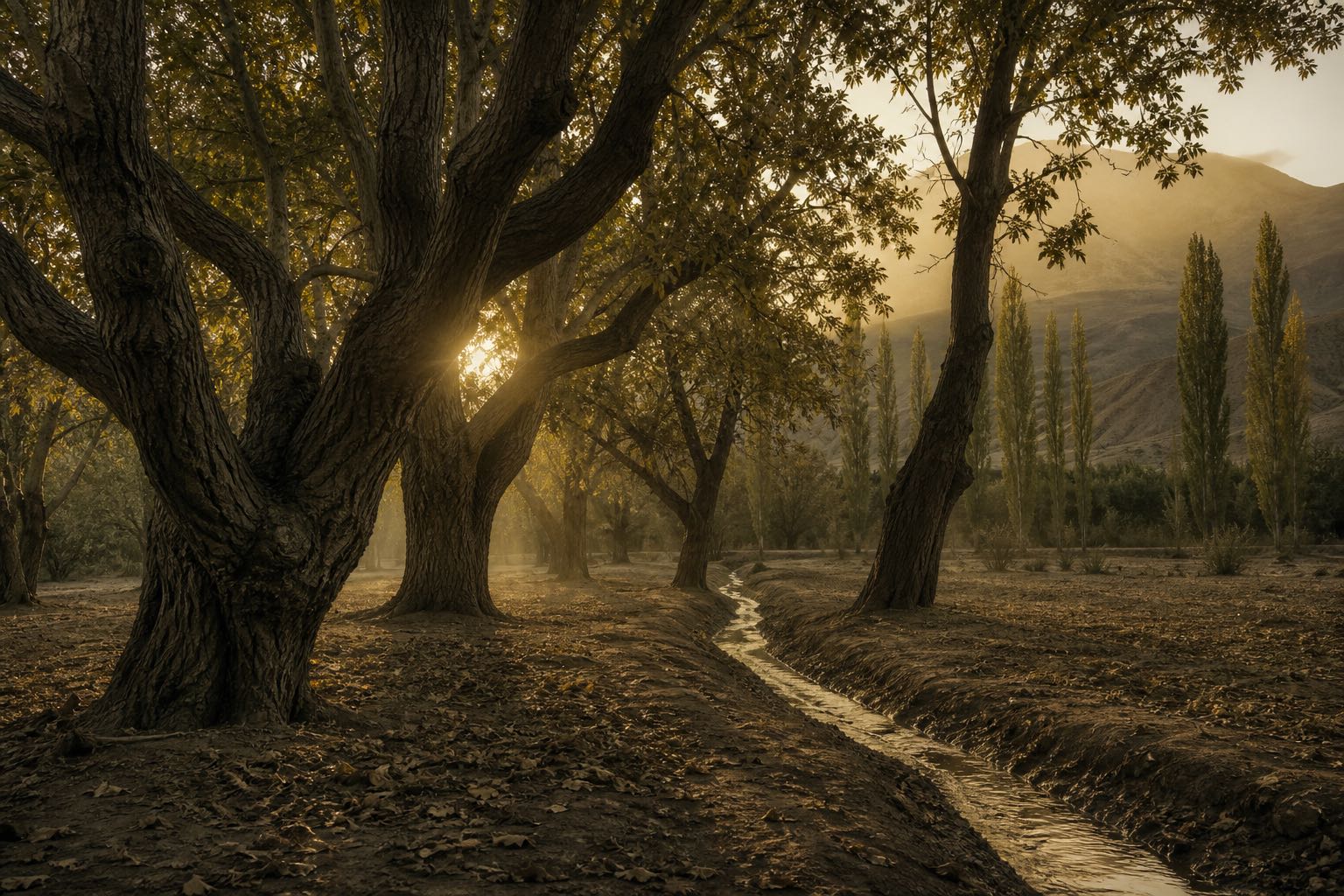
In Europe a walnut tree stands out from a distance: alone in a field, or in a row in an orchard that does nothing else. In Khotan it shares. Irrigable land is counted, so the tree does not get it to itself: it is planted along the channels, beside the tracks, in courtyards, and above all over the crops — wheat, maize and cotton grow at its foot.
This is not a local curiosity, it is the ordinary way of farming here. The tree gives shade and a nut; the field underneath goes on giving its harvest. The orchard planted in blocks, as in Europe or California, is the exception.
Here the tree does not make an orchard. It shades a field of wheat.
What the oasis demands
The walnut is hard to satisfy. It needs a winter cold enough to send it fully dormant, a spring that has finished frosting by the time it wakes — it comes into leaf late, precisely to miss the last frosts — and then a hot dry summer to fill the kernel.
Khotan gives it that without effort: a clear sky, a long burning summer, a decisive winter. What the place does not give is rain — a few centimetres in a year, which is to say none. All the water comes from Kunlun snowmelt, carried by channels to the foot of the tree. Elsewhere, growing walnuts means correcting the climate. Here it means moving water.
Harvesting between the fields
You do not harvest this the way you harvest a block of orchard. The trees are scattered, mixed in with the crops, often old and tall: it is done tree by tree. In autumn, when the husks split and the nuts drop, they are gathered, hulled, and put out to dry.
It is slow, and it has two consequences for anyone buying: consistency is judged lot by lot, on the goods themselves, and the calendar follows the harvest before it follows the trading year.