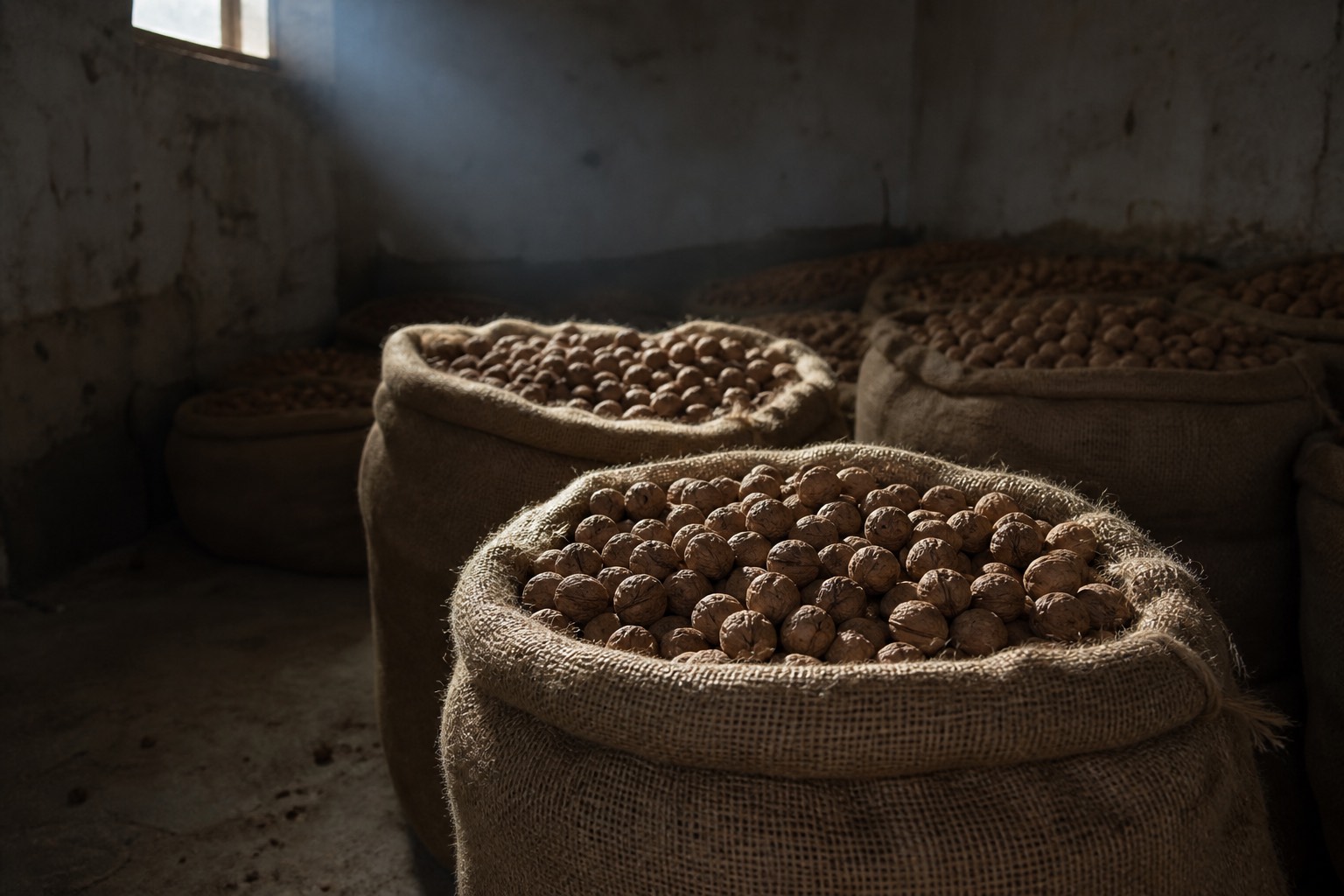
Jupiter's acorn
Juglans regia breaks into two pieces of Latin: Jovis glans, the acorn of Jupiter, and regia, royal. The Romans were not troubled by modesty when naming things they liked to eat. They had discovered nothing, though: they received the tree, as the Greeks had before them, by way of Persia.
It took the name of every stop on the journey, and never the name of its own country.
A caravan commodity
The walnut travels remarkably well: dense, nourishing, armoured in its own shell, able to keep for months with nothing more than a dry place to sit. It followed the routes that linked the oases of Asia to the Mediterranean — Khotan was one of their staging posts. They are now called the Silk Road, a nineteenth-century name for a network far older and far more varied than silk.
Along the way it took the name of the previous stop rather than of its own country. Russian says "Greek nut", because it arrived with Greek merchants. English says English walnut, because it arrived on English ships. Nobody named it after where it actually comes from.
Then Europe planted it
Rome did what Rome did: it planted. The walnut followed the roads and the monasteries across Gaul, Spain and the Rhine valley, out to the line where frost stops it. The great orchards of the Dauphiné and the Périgord, and later those of California, all descend from trees that set out from Asia.
It is a commercial history as much as a botanical one. The walnut moved because it sold — and it still sells on the same qualities: it keeps, it travels, and it is welcome everywhere.